Five years ago, media outlets and commentators vehemently and harshly predicted that Mexico’s pension funds managers, Afores, would disappear as a consequence of the government’s decision to drastically cut the fees charged to affiliated workers to around half a percentage point from the average of 1%.
No one offered projected cash flows or numerical assumptions that would give meaning to the predicted catastrophe or serve as a basis for a coherent argument. Amid the stridency, the only reference —inappropriate as a supposed argument— was the percentages applied in the region’s pension systems, ignoring the low commissions in the US and Europe.
The Keys to Viability
On the contrary, in a couple of articles published in FundsSociety, I argued that the pension fund manager business was and remains viable despite the cuts. See https://www.fundssociety.com/es/opinion/sobre-la-desaparicion-de-afores-y-el-fin-de-la-competencia-al-topar-comisiones-precisiones-y-reiteraciones/
In the analysis I presented the estimated asset figures (since they are the basis for applying the fees), from one to ten years, considering the progressive increase in the contribution rate, a constant and moderate annual return and, based on this, the income assumptions that the Afores would have after the significant reduction of fees.
The calculations supported the two points of the thesis:
1) Managers would equal their 2020 income levels in approximately three and a half years;
2) The exponential growth of assets could be at least as high as it had been before the cut, further boosted by the addition of new employees to the system; and that, consequently, the managers would match, in approximately three and a half years, the income they were generating then; and that, from then on, they would earn more.
These arguments and figures were harshly rejected, although without offering alternative accounts to refute them. As if the media frenzy replaced or outweighed the necessary substance.
After five years, there would be no need to illustrate, because they are obvious, two sound realities that nobody talks about:
- As the analysis concluded, no pension fund manager (Afore) has disappeared and competition has not ceased. At this point, both phenomena can be ruled out.
- In some periods, such as in 2025, profitability, the main driver of savings growth, reinforced the central thesis of the notes: an investment regime with a significant weighting in risky assets, as in Chile (the archetype of the Mexican system), fosters exponential asset growth, causing managers’ profits to increase at a faster rate.
Forecasts vs. Actual Results
How did the three key estimates for 2025 presented in those notes compare with the actual results?
- The forecast indicated that assets in SAR (Mexican Pension System) would be around 8.4 trillion Mexican pesos (MXN). According to data from CONSAR (National Commission of the Retirement Savings System), the assets managed by the system as of last December totaled 8.3 trillion pesos.
- Fee income for all the Afores would reach 39.5 billion pesos. According to the regulator, income for the year totaled 40.1 billion pesos.
- The total revenue forecast for managers, starting from the beginning of the sharp reduction in fees, was 178 billion pesos for the first five years. According to official data, income during that period totaled 173 billion pesos.
All these figures are round numbers. The predictions of numbers for other periods were not as accurate, although they were similar. (Figures in pesos. Converted to dollars, the comparison would not be appropriate)
FORECAST vs. REALITY. 2021 – 2025. Millions of pesos, MXN
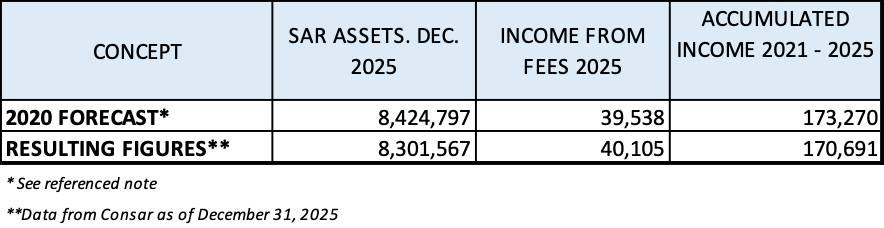
It is clear that the managers, as well as the regulator, could have made the prospective calculations with more detail and precision. I assume they did the task, but in any case, they didn’t publish any results. Neither the media nor commentators showed any interest in them. I imagine the underlying reason (if they did do the calculations) is that they would have reached the same conclusions: the managers weren’t going to disappear, but after five years they would be earning as much as, or even more than, when the fee rate hovered around 1%.
The Basis of Competition
The other argument in the notes suggested that the driving force behind competition, as it has been since the system’s inception, would continue to be profitability. Even under the previous high-fee scheme, the difference of 0.23% to 0.19% that prevailed from 2018 to 2020 between the most expensive and the cheapest fund manager was not, in practice, a factor that workers considered when choosing an Afore.
Not even if the difference had been greater. I expressed this opinion in various collaborations each time the table that would apply for the following year was released, and I stated that it was not appropriate for the regulator to promote it as a decision element.
The exercise was simple and irrefutable: if the annual return generated by the expensive Afore is 10% and that of the cheaper one is 9.00%, it’s advantageous to be registered with the expensive one. This wasn’t a supposition but a stark reality, as the constant was that the managers with the higher fees outperformed the cheaper ones. In 2025, the advantage of the former over the latter reached up to five percentage points. The benefit of a single year’s return would be enough to justify remaining with one of the expensive managers for three years or more, even if the cheaper one offered a «zero» (0.00%) fee.
Under the current scheme of equal percentages, and until recently, it was unacceptable that the regulator continued to present the ridiculously small difference of two basis points in fees as decisive for choosing an Afore (choose, change or remain in one of them).
Retirement savings are a sensitive issue that impacts society as a whole. Most Mexican media outlets believe that catastrophic predictions about the pension system and warnings that workers’ money will be stolen or disappear are a good way to incite the masses against the government. That’s why they seek out, invent, or exaggerate risks and dangers. And that’s why they don’t ask for alternative opinions, much less refute, correct, or even mention their own failed predictions. Unfortunately, this is something that will continue to happen.


Deja una respuesta